

| |
The Foundation
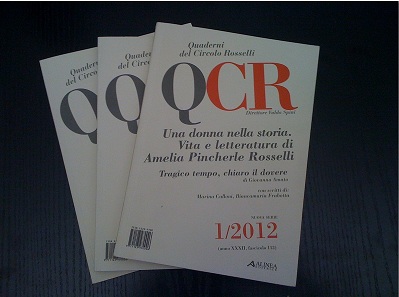
Fondazione Circolo Rosselli's
mission is to study, deepen, promote and debate the main
cultural, political, economical and sociological issues
that interest our modern society.
The Foundation
promotes meetings, conferences, lectures and talks about
today’s fundamental issues.
To achieve these goals the Foundation works in collaboration
with the Circolo di Cultura Politica Fratelli Rosselli
and other clubs and foundations worldwide.
The President of Fondazione Circolo Rosselli is Prof. Valdo Spini MP
In 1920, a group of young men, headed by Gaetano Salvemini , founded the Circolo di Cultura ( Cultural Circle ) in Florence . Among their number were the brothers Carlo and Nello Rosselli , Piero Calamandrei , Ernesto Rossi , and Alfredo and Nello Niccoli. The Cultural Circle was not associated with a particular political party, but rather an open forum in which its members might express their opinions as freely as they wished. It was frequented above all by the younger generation, and in its early days the Circle's small nucleus of regular members met once a week at the house of Alfredo Niccoli, a lawyer by profession.
In April 1923 the Circle became more organized and had its own premises at no. 27, Borgo Santi Apostoli. Thanks to the efforts of the Rosselli brothers, a well-stocked library was set up with a good selection of Italian and foreign periodicals. Among those responsible for the running of the Circle were Salvemini, the Rosselli brothers, Ernesto Rossi , Piero Jahier, Piero Calamandrei and Enrico Finzi.
The first phase of the Cultural Circle 's activities came to an abrupt end in 1924 in the wave of Fascist violence which followed the murder of Giacomo Matteotti. The Circle had assumed a decidedly anti-fascist position, and on the 31st December 1924 its premises were broken into and the archives destroyed. The Circle was officially closed on the 5th January 1925 by order of the Prefecture. At this point a long battle against fascism began, with the young men of the Cultural Circle fighting in the front lines. Some of the more important events of this period were: the publication of the first clandestine antifascist newspaper, Non Mollare ; the founding of the Movimento di Giustizia e Libertà (Justice and Liberty movement) by Carlo Rosselli , an early theorizer of liberal socialism; the murder of the Rosselli brothers on the 9th June 1937 at Bagnoles de l'Orne in France; and the founding of the Partito d'Azione (Action Party).
It was the Florentine Partito d'Azione , led by Tristano Codignola, that refounded the Cultural Circle after the Liberation of Italy in October 1944. The Circle became known as the Circolo di Cultura Politica Fratelli Rosselli (CFR - The Rosselli Brothers Cultural and Political Society). This marked the beginning of the second phase of the Circle's history, with Piero Calamandrei as its President. In more recent times, Giorgio Spini and Enzo Cheli have been Presidents of the CFR. The Circle has continued to be active ever since it was reformed, partly thanks to the periodical intakes of talented young men and women. Its wide-ranging activities have been of importance not only within the city of Florence and Tuscany , but also on a national and international level. Recently the Circolo Fratelli Rosselli Foundation was set up. Both it and the CFR itself are non-profit-making associations. ESSENTIAL BILIOGRAPHY
OF WORKS RELATED TO CARLO AND NELLO ROSSELLI IN ENGLISH:
- Mitchell Cohen e Michael Walzer, “The
Liberal Socialism of Carlo Rosselli,” Dissent (Winter
1994).
- Urbinati, Nadia. "The Liberal Socialism
of Carlo Rosselli," Dissent, Winter 1994: 113-16
- Massimo Mangilli-Climpson, Men of Heart
of Red, White, and Green: Italian Anti-Fascist Volunteers
and the Spanish Civil War (New York: Vantage Press, 1985)
- H. Stuart Hughes, Prisoners of Hope:
The Silver Age of the Italian Jews, 1922-1974 (Cambridge:
Harvard University Press, 1979)
- Joel Blatt, “Carlo Rosselli’s
Socialism,” Italian Socialism: Between Politics
and History, edited by Spencer Di Scala (Amherst: University
of Massachusetts Press, 1996)
- Blatt, Joel. "The Battle of Turin,
1933-1936: Carlo Rosselli, Giustizia e Libert*, OVRA
and the
origins of Mussolini's anti-Semitic Campaign," Journal
of Modern Italian Studies, vol. 1,
n. 1, Fall 1995.
- Nadia Urbinati,
Introduction to Carlo Rosselli, Liberal Socialism. Princeton
University Press, 1994.
- Ciuffoletti, Zeffiro. "Nello Rosselli:
A Historian Under Fascism," Journal of Italian History
I, n. 2, Autumn 1978: 287-314.
- Delzell, Charles F. "The Assassination
of Carlo and Nello Rosselli: Closing a Chapter of Italian
Anti-Fascism," Italian Quarterly XXVIII, n. 107 Winter
1987: 47-64.
- Delzell, C. Mussolini's Enemies: The
Italian Anti-Fascist Resistance. Princeton: Princeton University
Press, 1961. Reprint, New York: Howard Fertig, 1974.
- Gage, Mary Lynn. "The Campaign of Giustizia
e Libert*: The History of an Anti-Fascist Movement," unpublished
M.A. thesis, Vanderbilt University, 1974.
- Pugliese, Stanislao. “Death in
Exile: The Assassination of Carlo Rosselli,” Journal
of Contemporary History, July 1997, vol. 32, issue 3.
- Pugliese, S. G. Carlo Rosselli: Socialist
Heretic and Antifascist Exile. Harvard University Press,
1999.
- Salvemini, Gaetano. Carlo and Nello Rosselli:
A Memoir. London: For Intellectual Liberty, 1937.
Today in Spain, Tomorrow
in Italy Carlo Rosselli
(From “Fascism, Anti-fascism and The
Resistance in Italy,” edited by Stanislao G. Pugliese,
Rowman & Littlefield, 2004)
Carlo Rosselli (1899-1937)
was born into a wealthy Jewish family with strong ties
to the Risorgimento. Abandoning a promising career as a
professor of political economy, he joined the antifascist
cause and was instrumental in publishing the first underground
antifascist newspaper. Arrested for his activities, he
was sentenced to confino on the island of Lipari, off the
coast of Sicily. After a daring escape, he made his way
to Paris where, in 1929, he founded Justice and Liberty,
the largest and most influential non-Marxist leftist movement.
From Paris, Rosselli wrote essays, organized the movement,
and even plotted Mussolini’s assassination. When
the Spanish Civil War broke out in 1936, Rosselli was one
of the first to arrive in Barcelona in defense of the Spanish
Republic. Rosselli believed that the Spanish Civil War
had to be transformed into a European-wide offensive against
fascism and Nazism. That idea, and this speech, given over
Radio Barcelona on 13 November 1936, may have sealed his
fate. An anonymous police spy wrote to Rome that Rosselli
was “the most dangerous of the antifascists in
exile” and that it was necessary that he be “suppressed.” While
recuperating in the French countryside, Rosselli was assassinated,
together with his brother, the noted historian Nello, on
9 June 1937.
Comrades,
brothers, Italians, listen.
An
Italian volunteer speaks to you from Radio Barcelona to
bring you the greetings of the thousands of exiled Italian
antifascists that are fighting in the ranks of the revolutionary
army.
An
Italian column has fought for three months on the front
in Aragon. Eleven dead, twenty wounded, the esteem of our
Spanish comrades: here is the testimony of its sacrifice.
A
second Italian column, formed just in these days, heroically
defends Madrid. In all sectors of the front, Italian volunteers
are found, men who having lost liberty in their own land,
begin to regaining it in Spain, rifle in hand.
Daily
the Italian volunteers arrive: from France, from Belgium,
from Switzerland, from the distant Americas. Wherever there
are Italian communities, committees are being formed for
proletarian Spain. Even from oppressed Italy volunteers
depart and arrive in Spain. In our ranks we count dozens
of companions who have crossed the frontier covertly,
risking a thousand dangers. The young ones who have abandoned
the university, the factory, even the barracks, fight alongside
anti-fascist veterans. They have deserted the bourgeois
war to participate in the revolutionary war.
Italians,
listen. This is an Italian volunteer who speaks to you
from the radio from Barcelona. A century ago enslaved Italy
kept silent and quivered under the heel of Austria, of
the Bourbons, of the Savoy, of the priests. Every effort
of liberation was brutally repressed. Those people who
were not in jail were forced to the exile. But in exile
they did not renounce the struggle. Santarosa in
Greece, Garibaldi in America, Mazzini in England, Pisacane
in France, together with so many others, no longer able
to fight in their country, struggled for the freedom of
other peoples, showing to the world that Italians
were worthy of living freely. From those sacrifices, from
those examples, the Italian cause was consecrated. The
Italian reacquired faith in their strengths.
Today
a new tyranny oppresses us – a
great deal more ferocious and humiliating than the ancient
one. It is not longer the foreigner that dominates. It
is we who have allowed a factious minority to subdue us;
using the strengths of privilege, it holds in fetters the
working class and the thought of all Italians.
Every
effort seems vain against the massive, dictatorial army.
But we don't lose faith. We know that dictatorships pass
away and that the people remain. Spain furnishes us
with the pulsating proof. Nobody speaks anymore of De Rivera.
Nobody will speak tomorrow about Mussolini. And as in the
Risorgimento, in the darkest time, when almost nobody dared
to hope, from abroad the example and the incitement came,
so today we are convinced that modest effort of the Italian
volunteers, will find tomorrow a powerful will for redemption.
It
is with this secret hope that we have hastened to Spain:
today here, tomorrow in Italy.
Brothers,
Italian comrades, listen. This is an Italian volunteer
who speaks to you from the radio in Barcelona.
You
believe the false news of the fascist press, which depicts
the revolutionary Spanish people like hordes of bloodthirsty
crazy persons on the eve of defeat. The revolution in Spain
is triumphant. Every day it penetrates more and more into
the depth of the life of people, renewing institutes, correcting
secular injustices. Madrid has not fallen and it won’t
fall. When it already seemed inevitable that it would succumb,
a marvelous uprising of people halted the invasion and began
the counteroffensive. The motto of the revolutionary militia,
which until then was “No pasar*n,” [they shall
not pass] has become “Pasaremos,” [we will
pass]; that is, not the fascists but us, the revolutionary
ones, will overcome.
Catalonia,
Valencia, the whole Mediterranean littoral, Bilbao and
one hundred other cities, the richest zone, the most evolved
and industrious of Spain, is solidly in the hands of revolutionary
forces.
A
new order has been born, based on liberty and social justice.
In the workshops, the boss no longer commands, but the
collective, through suggestions of factory and labor unions.
In the fields, one no longer finds wage earners forced
to do a weary job in the interests of others. The farmer
is master of land that he works under the control of the
local town hall. In the offices, the employees, the technicians
no longer obey a hierarchy of “daddy’s
boys,” but a new hierarchy founded on ability
and free choice. They obey, or better they collaborate,
because in revolutionary Spain and above all in libertarian
Catalonia, the most audacious social conquests are made
respecting the personality of the man and the autonomy
of human groups. Communism, yes, but libertarian communism.
Socialization of the large industries and large-scale commerce
but no idolatry of the state: the socialization of the
means of production and exchange. This is conceived as
a means to freeing man from all slavery.
The
experience in progress in Spain is of extraordinary interest
for everybody. Here, there is no dictatorship, no military
economy, no denial of the values of the west but conciliation
of the most ardent social reforms with liberty. There is
no one party that, pretending to be infallible, seizes
the revolution: anarchists, communists, socialists, republicans
all collaborate for the public, at the front, in social
life. What a lesson for us Italians!
Brothers,
Italians, comrades, listen. An Italian volunteer
speaks to you from the radio in Barcelona to bring you
the greetings of the Italian volunteers. On the other bank
of the Mediterranean a new world is being born. It is the
antifascist uprising that begins in the West. From Spain
it will conquer Europe. Above all, it will arrive in Italy,
so near to Spain in language, traditions, climate, customs
and tyrants. It will arrive because history cannot not
arrested, progress continues, dictatorships are parentheses
in the life of the people, almost a whip to spur them,
after a period of inactivity and abandonment, to take back
in hand their destiny and fate.
Italian
brothers who live in the fascist jail, I would like that
you were able, just for an instant at least, to plunge
yourselves in the intoxicating atmosphere in which this
marvelous people have been living for months, despite all
the difficulties. I wish that you could go in the workshops
to the enthusiasm that the people have for the fighting
comrades; I wish that you could cross the countryside and read
on the face of the farmers the boldness of this new dignity
and above all to cross the front and to talk to the
volunteer militiamen. Fascism, which cannot trust any of
the soldiers who pass en masse to our lines, must resort
to mercenaries of all types. Instead, the proletarian barracks
swarm with a crowd of young people pleading for weapons.
A month of this life, spent for of human ideals, is worth
more than ten years of vegetation or false imperial
mirages in Mussolini’s Italy.
And
don’t even believe the fascist press when it paints
Catalonia, largely anarchist/syndicalist, prey to terror
and disorder. Catalan anarchism is a constructive socialism,
sensitive to the problems of liberty and culture. Every
day furnishes proofs of its realistic qualities. The reforms
are completed with order, without following preconceived
schemes and always holding in account experience. Barcelona
has given us the best proof, where, despite the difficulties
of the war, life continues to unwind regularly and the
public services work better than they did before.
Italians
who listen the radio of Barcelona, attention. Volunteer
Italians fighting in Spain, in the interest and for the
ideal of a whole people that struggle for its liberty,
ask you to prevent that fascism continues its criminal
work in favor of Franco and of the factious generals. Every
day airplanes furnished by Italian fascism and driven by
mercenary aviators who dishonor our country, launch bombs
against unarmed cities, tearing to pieces women and children.
Every day, Italian bullets, built with Italian hands, transported
by Italian ships, launched by Italian guns, fall
in the trenches of the workers. Franco would already have
lost some time ago, if it had not been for the powerful help
of fascism. What shame it is for Italians to know that
their own government--the government of a people who was
once in the vanguard of the struggle for liberty-- tries
to murder the liberty of Spanish people!
Proletarian
Italy, awake. Stop this shame. Italian factories and Italian
harbors should not send any more murderous weapons. Where
open boycotting is not possible, resort to secret sabotage.
The Italian people must not become the police officer of
Europe.
Brothers,
Italian comrades, an Italian volunteer speaks from the
radio of Barcelona in the name of thousands of Italian
fighters.
Here
one fights, one dies, but one also wins for liberty and
the emancipation of all the people. Italians, help the
Spanish revolution. Prevent fascism from supporting
the factious and fascist generals. Collect money, and if,
for repeated persecutions or for insurmountable difficulty
you are not able in your center to fight the dictatorship
effectively, hasten to strengthen the columns of volunteer
Italians in Spain.
The
faster proletarian Spain wins, the sooner will come
the time for the uprising of the Italian people.
Italy
is a great country, yes, but in the workshop the despotic
master commands. Italy is great, yes, but if someone dares
to say what he has in his heart, he is quickly caught by
the Special Court. Italy is great, yes, but there is a
racket in the schools, in the professions, in the offices:
the reign of fascist officials, secretaries, under-secretaries, relatives
of the secretaries and under-secretaries, while the noblest
spirits of our country are forced into the most disheartening
silence. We are in short great, imperial, strong. . . but
we don’t enjoy a simple, elementary law: to live
as men, humanly, to the service of those two ideal principles
for which life is only worthy, by which societies progress:
justice, liberty. To you Italians I speak. Free Italians,
courage! On the other shore of the Mediterranean a new
world is born. The revolution arrives, triumphant, against
fascism, anti-fascism . . For centuries our Spanish brothers
were enslaved, as in Italy and other countries . . . You
know the history . . . But the people this time are ready.
People, not the government. . .
Those
people who believe by now that the revolution will fail
are dreaming. The revolution wins. . . It is a natural
and inevitable phenomenon. The men who have slacked their
thirst at the eternal source of liberty - of a positive
liberty, not only political, but economic and social -
those men are determined that they will no longer return
to servitude. Rather than surrender, they will defeat everyone.
Carlo Rosselli, “Oggi
in Spagna, domani in Italia” in Oggi in Spagna,
domani in Italia (Turin: Einaudi, 1967), pp. 70-75; translated
by Stanislao G. Pugliese; see also Stanislao G. Pugliese,
Carlo Rosselli: Socialist Heretic and Antifascist Exile
(Cambridge, MA: Harvard University Press, 1999).
|
|